12 Day Shanghai - Zhouzhuang Water Town - Suzhou - Hangzhou -Xian - Beijing Tour
OVERVIEW
Day 1: Shanghai-Arrival
Day 2: Shanghai:Oriental Pearl TV Tower, Shanghai Historical Development Museum,Huangpu River Cruise, Bund, Nanjing Road
Day 3: Shanghai: Yu Garden, Shanghai Old Town, French concession Xintiandi, Jade Buddha Temple
Day 4: Shanghai-Zhouzhuang water town -Suzhou:The Connected Bridge, Shen’s Family Mansion, Zhang’s Family Mansion
Day 5: Suzhou - Hangzhou: The Lingering Garden, Pan Gate Ancient City Wall, Tiger Hill
Day 6: Hangzhou to Shanghai: Cruise on the West Lake, Lunch on your own arrangement, Lingyin Buddha Temple & Flying Peak, Longjing/Dragon Well Tea Village
Day 7: Shanghai - Xi’an by High speed train-Xi’an arrival
Day 8: Xi’an Tour with Terracotta Warriors, and Huaqing Pool
Day 9: Xi’an City Tour with Big Wild Goose Pagoda, Xi’an City Wall, Shaanxi History Museum, Great Mosque, Muslim Food Street, Transfer to airport or station for departure (Xian-Beijing by High speed train-Beijing-Arrival)
Day 10: Tiananmen Square, Forbidden City, Temple of Heaven, and Summer Palace
Day 11: Mutianyu Great Wall, and Dingling
Day 12: Beijing - Departure
ITINERARY
Day 1: Shanghai-Arrival
Upon arrival, our driver will hold a welcome sign to meet you and transfer you to the hotel.
Day 2: Shanghai
Breakfast at hotel then meet your guide and driver at the hotel lobby. Visit the Oriental Pearl TV Tower which is the third tallest Tv Tower in the world. The transparent sightseeing gallery is located on the second main sphere with a circumference 150 meters and a width of 2.1 meters. Tourists can overlook the panoramic view of the Huangpu River through the transparent glass at your feet which make visitors feel like walking in the cloud. Shanghai Historical Development Museum is located beneath the below the Oriental Pearl Radio & TV Tower and was founded in 1983 and formally opened to the public on May 27, 1984. It is a comprehensive museum reflecting the development of Shanghai and surrounding areas from every aspect by means of more than 1,300 cultural artifacts, literature, and pictures. It presented a holistic picture of the long history of Shanghai from remote antiquity to the liberation of the city in 1949. The displays covered Shanghai civilization for over 6000 years including Ma Jia Bing Culture, Songze Culture and Liangzhu Culture. It also reflected local history from the First Opium War in 1840 when Shanghai was forced to operate as a treaty port and then the foreign concessions become a key part of Shanghai’s history and later liberation. A Huangpu River Cruise is one of the best ways to see both old and new Shanghai. As you sail down the river towards the East Sea enjoy the views of the full sweep of The Bund and the 21st century cityscape of Pudong. The Bund shows off Shanghai’s outstanding foreign buildings, most of which were erected before 1937. It is the emblem of Shanghai and the area used to be British concession. Nanjing Pedestrian Street is China’s No. 1 Commercial Street and one of the top 10 famous streets in Shanghai. Its unique prosperous hustle and bustle has made Nanjing Road a “Prime Site” in Shanghai and a must visit tourists. Drop-off service at your hotel and end today trip.
Day 3: Shanghai
Breakfast at hotel and meet your guide and driver at your hotel in the morning. Yu Garden is a famous garden of classical style in the south of the Yangtze River. Initially built under the reign of Jiajing in the Ming Dynasty and up to now it has a history of over 500 years. The major scenic attractions in the Yu Garden include the Mountain and Forest in City, Pretty Woods and Elegant Dale, Charming Spots by the Spring Hall, Eye-catching Scenes of Water and Rockeries, etc. Shanghai’s Old Town is home to historic buildings, long histories and unique customs can be found in there. It reflects the way of life and cultural traditions of the past and present Shanghai people. French Concession Xintiandi is the top choice in French Concession. It has been a Shanghai icon for over a decade. An upmarket entertainment and shopping complex modelled on traditional alleyway (lòngtáng) homes. This was the first development in the city to prove that historical architecture makes big commercial sense. Jade Buddha Temple of Shanghai originally built in 1882 of Qing Dynasty (1638-1911). It is a temple to enshrine two jade Buddha statues which were brought from Burma by the monk from Mount Putuo temple, hence obtaining the name. Drop-off service at your hotel and end today trip.
Day 4: Shanghai - Zhouzhuang water town -Suzhou
Breakfast at hotel and meet your guide and driver at your hotel in the morning. Zhouzhuang Water Town is known as the “number one water town” in China. Zhouzhuang is in UNESCO’s World Heritage Centre Tentative List and in the first batch of the national 5A scenic spots. The destination preserves traditional architecture with distinct riverside features including revetments, arch bridges, white Connected Bridge The Connected Bridge refers to the Shide Bridge and the Yong’an Bridge attached to each other during the period between 1573 and 1619. Seen from above, the connected bridges is an arch bridge and a flagstone bridge which resemble a key used in the past. The late famous artist Chen Yifei (1946-2005) painted the two bridges into his famous work Memory of Hometown in 1984 and won countless praise for the beauty of this enchanting waterfront town, walls and black tiles. The Hall of Shen's Residence originally known as Jingye Tang was built by Shen Wansan's (a legendary tycoon) in Ming Dynasty. Today, it is a Major Historical and Cultural Site Protected at Jiangsu provincial level. It enjoys great popularity among visitors. Zhang’s Family Mansion is one of a handful of Ming Dynasty (1368-1644) structures preserved in Zhouzhuang. The Zhang Family Mansion covers an area of more than 1,800 square meters with dozens of rooms and a private garden. It was listed as the one of the foremost protected cultural heritage sites in Jiangsu province. Overnight stay at Suzhou
Day 5: Suzhou- Hangzhou
Breakfast at hotel and meet your guide and driver at your hotel in the morning. Lingering Garden was built in the year of 1593 Ming Dynasty. The garden was selected to be one of the first batch of places enjoying the status of the key cultural and historical relic site under state-level protection. It has been known as one of the “Four Famous Classic Gardens”, and was included in UNESCO’s the World Cultural Heritage List in 1997. In 2010, the garden added to the list of national 5A-level scenic areas. Pan Gate Ancient City Wall known as Panmen or Pan Gate was built in 514 and was one of the eight gates of the capital of Wu Kingdom. As a landmark of the ancient city of Suzhou, Panmen is the only existing ancient parallel city gate for both land and water in China. Tiger Hill, according to historical records, the King of Wu Helu was buried on the hill and was called "the Hill Emerging from the Sea". The legend goes that three days after his burial a white tiger appeared squatting on the hill hence the name. The Yunyan Temple Pagoda and the Sword Pool are well-known features of the hill. With a history going back more than 1,000 years, the simple, archaic and imposing Yunyan Temple Pagoda, also known as the Second Leaning Tower on earth stands aloft at the top of the hill, serving as a symbol of ancient Suzhou for years, The Tomb of the Wu King Helu under the Sword Pool has remained an unsolved mystery for two and a half millennia. It takes about 2-3 travel hours to Hangzhou. Overnight stay at Hangzhou.
Day 6 :Hangzhou to Shanghai
Morning Breakfast at hotel then meet your guide at your hotel. West Lake was chosen as a National Key Scenic Resort in 1982, named one of Ten Scenic Resorts in 1985, and selected as a national 5A tourist resort in 2006. In addition, a picture of the lake, "Three Ponds Mirroring the Moon," was printed on the backs of both the foreign exchange certificate and the yuan bill issued by the government in 1979 and the fifth version of the RMB one yuan bill issued in 2004. The West Lake Cruise is a beautiful, splendid journey. You can watch the shimmering waters and the many passersby. Sit on the boat and enjoy the lakes and mountains. Relax and watch the beautiful green waves on the lake. Feilai Feng (Flying Peak) faces the slopes of Lingyin Temple. Lingyin Temple has a history of more than 1600 years. The temple has a classical Jiangnan Temple layout. You can change the Lingyin Buddha Temple & Flying Peak to the Chinese Knife, Scissors and Sword Museum & Umbrella Museum or Chinese Knife, Scissors and Sword Museum & Umbrella Museum & Canal Cruise Tour. Two museums share a joint entrance hall. After watching the sword cutting and the umbrella museum next door, you can enjoy the cruise tour on the Grand Canal. The Grand Canal, known to the Chinese as the Jing–Hang Grand Canal, is a UNESCO World Heritage Site. It is the longest canal or artificial river in the world. Longjing Tea, or dragon well tea is more than 1200 years old, is the No. 1 tea in China, and is regarded as the “Green Queen”. Visit Longjing Tea plantations in Hangzhou to appreciate the charming, verdant sights and know more about the culture of tea and the Chinese nation. It takes about 3 travel hours to Shanghai.
Day 7: Shanghai-Xi'an-Arrival by Bullet Train
Our driver will pick up you from your hotel, then transfer you to the train station to Xi’an. Upon arrival at the Xi’an train station, our driver will pick up you from train station then transfer you to hotel in Xi’an.
Day 8: Xian Tour:Terracotta Warriors, Huaqing Pool
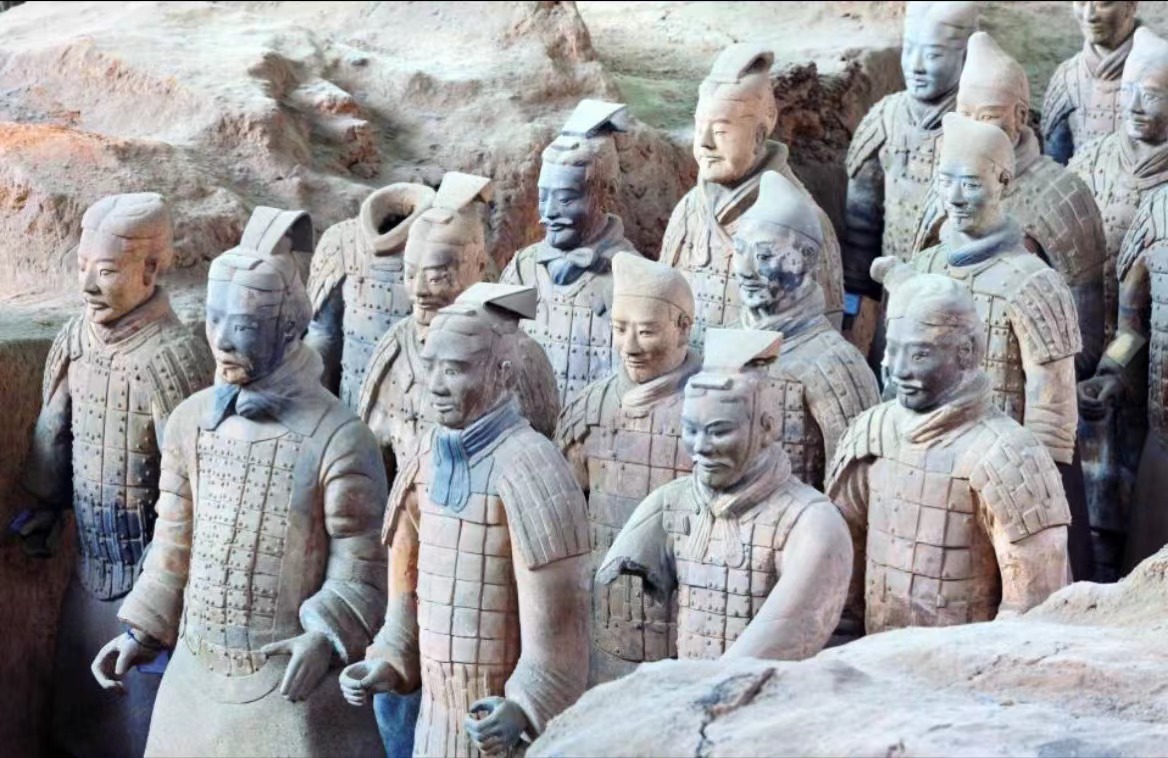
The Terracotta Army in Xi'an or Terracotta Warriors and Horses is a super large collection of life-size terracotta sculptures in battle formations, reproducing the mega imperial guard troops of Emperor Qin Shi Huang (259 - 210BC), the first emperor of the first unified dynasty of Imperial China. The Terracotta Warriors and Horses Museum renowned as the eighth wonder of the world. Huaqing Pool or the Huaqing Hot Springs is a complex of hot springs located in an area characterized by mild weather and scenic views at the northern foot of Mount Li which one of the three major peaks of the Qinling.
Day 9: Xian City Tour with Big Wild Goose Pagoda ,Xi’an City Wall, Shaanxi History Museum, Great Mosque, Muslim Food Street, Transfer to airport or station for departure (Xian-Beijing by High speed train-Beijing-Arrival)
Big Wild Goose Pagoda (Dayan Pagoda) is the symbol of the old-line Xi'an. Big Wild Goose Pagoda (also called Giant Wild Goose Pagoda) is a well-preserved ancient building and a holy place for Buddhists. The Xi'an City Wall is also known as the Fortifications of Xi'an and is the most complete city wall that has survived in China, as well being one of the largest ancient military defensive systems in the world. The Shaanxi History Museum in Xi'an, regarded as the pearl of ancient dynasties and house of Chinese treasures and it gives a miniature overview of the thousands of years of Chinese history and the splendid ancient cultures of olden times. The Great Mosque according to historical records engraved on a stone tablet inside. The Great Mosque was built in 742 during the Tang Dynasty (618-907). This was a result of Islam being introduced into Northwest China by Arab merchants and travelers from Persia and Afghanistan during the mid-7th century when some of them settled down in China and married women of Han Nationality. It is really well worth a trip to see the Great Mosque, not only for its centuries' old history but also for its particular design of mixed architecture - traditional Muslim and Chinese styles. The Huimin/Muslim Street is famous as a "snack street" because rich delicious local Xi'an delicacies and typical Shaanxi snacks are concentrated here which attract visitors home and abroad. Our driver will transfer you to the train station to Beijing. Upon arrival in Beijing, our driver will pick up you from train station then transfer to hotel in Beijing.
Day 10: Tiananmen Square, Forbidden City, Temple of Heaven, Summer Palace
Tiananmen Square is the largest public square in the world. Located in the heart of Beijing City. It is the site for massive parades and rallies which is the largest square of this kind in the world. This was the site when in 1949 from a rostrum on Tiananmen (the Gate of Heavenly Peace), Chairman Mao proclaimed the establishment of the People's Republic of China. Forbidden City is the Chinese imperial palace from the mid-Ming Dynasty to the end of the Qing Dynasty. For almost 500 years, it served as the seat-bed of the Emperors in Ming and Qing Dynasties as well as the ceremonial and political centre of Chinese government. Temple of Heaven was built for the emperors in ancient China to worship Heaven. It was inscribed on the World Heritage List by the UNESCO. The Summer Palace was originally named Qingyi Yuan or the Garden of Clear Ripples, and was first constructed in 1750. It was raised to the ground by the Anglo-French Allied Forces in 1860. The Government of the Qing Dynasty started to rebuild it in 1886 with funds that were misappropriated from the Imperial Navy and other sources. Renamed two years later as Yihe Yuan or the Garden of Health and Harmony and was supposed to serve as a summer resort for the Empress Dowager Cixi.
Day 11: Mutianyu Great Wall, Dingling
Mutianyu Great Wall is as one of the best-preserved parts of the Great Wall. the Mutianyu section of the Great Wall used to serve as the northern barrier defending the capital and the imperial tombs. First built in the mid-6th century during the Northern Qi, the Mutianyu section is older than the Badaling section of the Great Wall. During the Ming dynasty, under the supervision of general Xu Da, construction of the present wall began and built over the previous wall. In 1404, a pass was built in the wall. In 1569, the Mutianyu Great Wall was rebuilt and till today most parts of it are well preserved. The Mutianyu Great Wall has the largest construction scale and best quality among all sections of Great Wall. Dingling is one of the 13 Ming Tombs of the 13 emperors of the Ming Dynasty ( 1368 - 1644). From the Yongle Emperor onwards, 13 Ming Dynasty Emperors were buried in this area. You will visit Dingling and see the tomb of the Wanli Emperor which is the only one of the Ming Dynasty tombs excavated.
Day 12: Beijing-Departure
Our driver will pick up you from your hotel ,then transfer to the airport or train station.
Price includes:
All entrance fees listed in itinerary.
Professional English-speaking guide & driver + air conditioned vehicle.
Local Facility 4stars Hotel accommodations (Standard Room with twin share basis) as listed in the itinerary.
Round trip transfers between airports or railway stations and hotels.
Bullet Train tickets second class From Shanghai to Xian & Xian to Beijing
Service charge & Government taxes.
Custom-designed personal tours available upon request
Price Excludes:
Meals
Any Fees are not mentioned above
Tips for the guide and driver
Travel Insurance
ACKNOWLEDGMENT OF RISK & LIMITATION OF LIABILITY By booking and/or participating in any tour, travel or other service by AJFS TOURS, the client/ participant agree to the following terms: 1. The Participant acknowledges that all travel, and particularly adventure, group or foreign travel, involves inherent risks, including but not limited to: a)Accidents or illnesses in remote places without medical facilities; b) Dangers and risks inherent in activities like hiking, swimming, or local transportation; c) Force Majeure events such as acts of God, war, terrorism, government restrictions, weather and natural disasters. In all these events the participant/client, voluntarily assumes all risks associated with the travel services. 2. Exclusion of liability: AJFS Tours and its agents, employees, affiliates and representatives shall not be liable for any injury, loss, delay, including direct, indirect, consequential or incidental damages arising out of or related to the service by AJFS Tours and said exclusion of liability applies to but is not limited to damages or injury caused by the following: a) Acts or omissions of third party suppliers (e.g. Airlines, hotels, ground transporters, local operators, restaurants or guides) over whom AJFS Tours has no direct control; b) Personal injury or death, emotional distress, lost luggage, damage to property or theft unless caused by AJFS Tours’ gross negligence; c) Any cancellation, deviation or delay caused by weather, mechanical failures, government action or other events beyond the control of AJFS Tours. d) The participant’s or client’s failure to obtain adequate travel insurance, visas, passports or to follow local laws or instructions of AJFS Tours. 1. AJFS Tours acts solely as an agent of the various independent suppliers that provide transportation, accommodation and other services and AJFS Tours maintains no control, direct or indirect, over the personnel, equipment or operations of these various suppliers and makes no representations or warranties concerning their operations and performance. 2. AJFS Tours strongly recommends to all clients and/or travelers planning a local or international tour, to secure and obtain a comprehensive travel insurance before the client/traveler books or embarks on any journey or tour that they book with AJFS Tours.